




Hand & Skin Care
Wet Cement and Grease on Your Hands: Cleaning Up and Caring for Skin on the Jobsite
Wet cement is strongly alkaline and can burn skin. How to keep it off, clean up concrete on hands without solvents, and care for…
Read article → Shop the full professional line →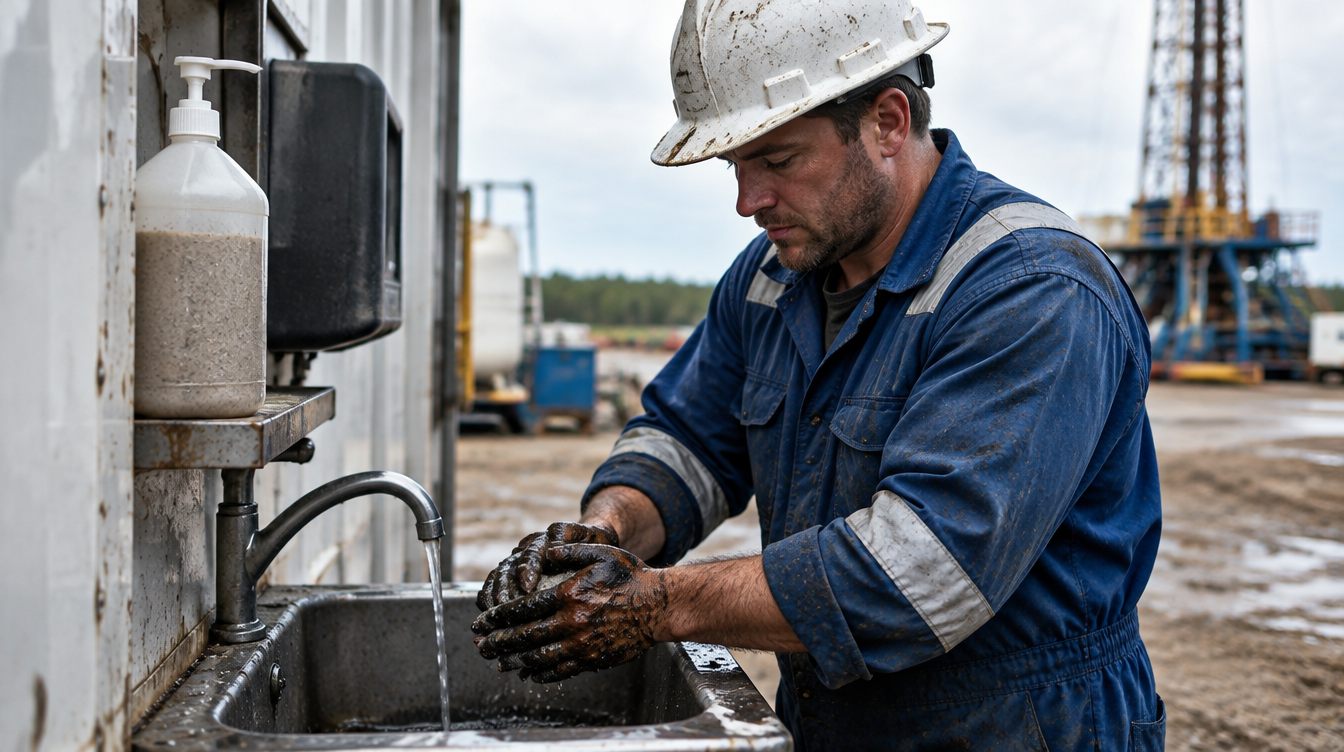
By the end of a hitch, crude, pipe dope and drilling mud are in every crease of your hands. It is under your nails and ground into your knuckles. The fastest fix on a lot of leases is still a rag soaked in diesel or parts cleaner. It works on the oil. It is hard on the skin under it.
This post is about what oilfield work does to your hands, and how to clean up at the doghouse sink or out on the pad without making things worse.
OSHA lists hazardous chemicals among the main health hazards in oil and gas extraction. Drilling and servicing use and produce a long list of them. Some are caustic and can cause chemical burns. OSHA also notes that sludge, drilling mud and pipe scale often carry elevated levels of naturally occurring radioactive material (NORM).
Your hands are where most of it lands. OSHA says most chemicals are readily absorbed through the skin. That can happen without you noticing. For chemicals that sit on tools, rails and work surfaces, the skin can matter more than the lungs.
Then there is the skin itself. NIOSH says contact dermatitis is the most common work-related skin disease, making up an estimated 90 to 95 percent of cases in the United States. On a rig, the usual triggers are the ones you handle every day: oils, solvents, mud and the harsh cleaners used to get them off.
Cracked skin is more than a comfort problem. It is a gap. Oil, mud and germs get into it, and it is harder to keep clean.
A construction-industry physician’s guide from CPWR lists solvents as a cause of both dry skin and irritant contact dermatitis. It lists abrasive cleaners and harsh alkaline soaps too. Solvents dissolve oil, and that includes the natural oils that hold your skin together. Do it every day and the skin’s barrier wears down.
Fuel and solvent also add their own chemicals to the mix. You are trying to get chemicals off your skin. Washing with more of them defeats the point.
The CDC adds a point that matters out here. Hand sanitizer may not work well on visibly dirty or greasy hands, and it may not remove harmful chemicals. Soap and water work better for that. Sanitizer is not a cleanup tool for crude.
When you have water, use it. A good wash-up looks like this:
We make I.C. Heavy Duty Hand Cleaner for this job. Pumice scrubbers and cleansers strip tar, oil, grease and carbon. It is solvent-free, so there are no hydrocarbon solvents in it, and benzalkonium chloride kills 99.99% of germs. It has a light lemon scent.
On a busy location, the gallon size with a gallon pump at the doghouse or wash trailer saves a lot of half-empty bottles rolling around the floorboard.
Plenty of pads have no sink, and you are not driving to town to wash before lunch. For those times, use a cleaner made to come off with a towel:
I.C. Antibacterial Waterless Hand Cleaner needs no rinse. Apply, scrub and towel off. Its micro scrubbers lift oil and grime, and benzalkonium chloride kills 99.99% of germs. It is alcohol-free and fragrance free. The single-use foil packets ride in a glove box or a vest pocket.
Clean hands still take a beating from wind, sun and the next day of gloves. Put something back on before you rack out. Dermatologists say to put hand cream on right after washing, while the skin is still slightly damp. I.C. Advanced Repair Hand Cream is a dimethicone skin protectant that helps prevent and temporarily protects chafed, chapped or cracked skin.
A few more habits help:
For the rest of the oilfield kit, from sun on the lease to bugs at remote sites, see our oil and gas skin care page.
No. The CDC says sanitizer may not work well on visibly dirty or greasy hands, and it may not remove chemicals. Get the oil off with a hand cleaner first, and wash with soap and water when you can.
Pumice is there for heavy soil. Use it at the end of the job, not every hour. Scrub firmly, not hard, and rinse well. If your skin is raw, ease off and give it a day with a smoother cleaner and hand cream.
Treat it like any other chemical on skin. Check the SDS for the products in that mud system, wear the gloves it calls for, and wash it off with soap and water as soon as you can. OSHA notes that mud and pipe scale can carry NORM, so wash before you eat or smoke.
Keep reading
Wet cement is strongly alkaline and can burn skin. How to keep it off, clean up concrete on hands without solvents, and care for…
Read article →What fume, soot and grinding dust leave on a welder's skin, what OSHA's chromium rule says about washing, and how to set up the…
Read article →Heat, sweaty gloves and heavy wash-ups crack a welder's hands. What to watch for, and a simple on-shift, end-of-shift and bedtime routine.
Read article →
Skin care that cares about the worker and about the work
Free samples for crews, safety managers and buyers. Buy direct, through your distributor or on GSA.

Welcome to the crew
Join our email list for your code, plus safety guides, new products and seasonal reminders. A few emails a month.
First order of $40 or more, one per customer. A few small sizes are excluded. Can't be combined with other codes. By signing up you agree to get marketing emails from R&R Lotion. Unsubscribe any time. Privacy Policy
You're on the list
Use it at checkout on your first order of $40 or more. We also sent a confirmation link to your inbox. Click it and we'll email the code so you have it for later.
Start shopping