




Hand & Skin Care
Work-Safe Hand Cream: What to Use Under Nitrile Gloves
Why work hands crack, what to look for in a lotion you wear under gloves, and when to put it on.
Read article → Shop the full professional line →
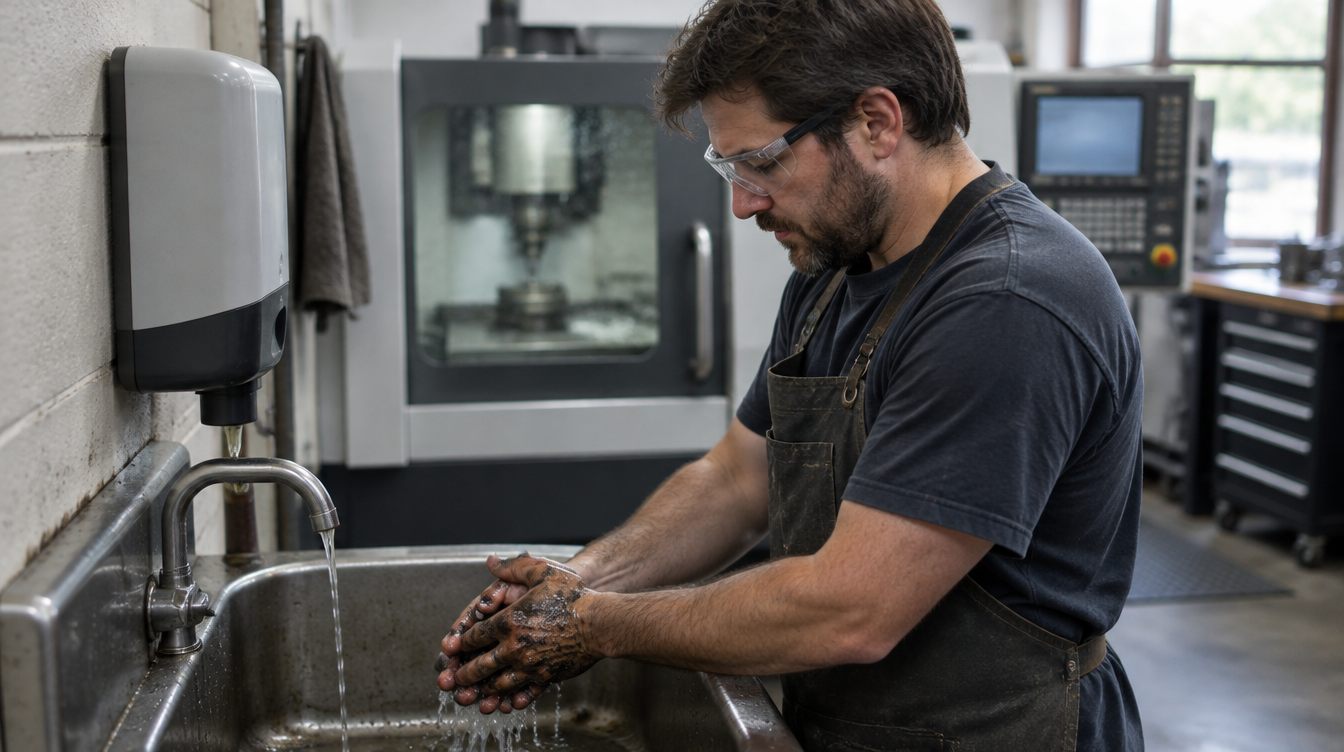
Machinists, maintenance techs and press operators spend the shift with their hands in it. Coolant on the parts. Way oil on the machine. Grease on every fitting. By break time your hands are slick and dark, and by Friday the skin on your fingers is rough, red and splitting.
Metalworking fluid dermatitis is one of the most common skin problems on a shop floor, and grease isn’t far behind. Here’s what they do to skin, why solvent cleanup makes it worse, and a simple routine for cleaning up shop hands.
Metalworking fluids (MWFs) cool and lubricate the tool and the part. They’re mixes of oils, water, emulsifiers, rust inhibitors and biocides. They get on your skin from the parts, the tools, the machine and the mist.
NIOSH says workers exposed to MWFs often report skin problems: irritation, oil acne and rashes. The most common are irritant and allergic contact dermatitis. There’s no exposure limit for skin contact, so NIOSH’s advice is simple: limit skin contact to prevent irritant and allergic skin reactions.
Coolant is the big one. In a NIOSH evaluation at a rifle barrel plant, workers whose skin touched coolant had significantly more work-related dermatitis than workers whose skin didn’t. NIOSH also notes that over 80% of work-related contact dermatitis involves the hands.
Grease and fluid don’t rinse off with water, so a lot of shops end up with a can of solvent or a rag soaked in parts cleaner by the sink. It works because it dissolves oil.
The problem is that it dissolves your skin’s oil too. Think of the outer layer of skin as a brick wall. The cells are the bricks, and natural oils and lipids are the mortar that holds moisture in and keeps irritants out. Solvents wash out the mortar. Then the next round of coolant gets in more easily, and the skin cracks.
NIOSH’s guidance in its field reports is direct: wash contaminated skin with soap and water, and don’t use solvents to clean your hands.
You need a cleaner strong enough for grease that doesn’t rely on solvents. I.C. Heavy Duty Hand Cleaner is a pumice scrub that strips tar, oil, grease, carbon and adhesives. It’s solvent-free, silicone-free and alcohol-free, and benzalkonium chloride kills 99.99% of germs. Silicone-free matters in shops that paint or coat parts, where silicone on hands can cause finish defects.
One thing to know: it has a light lemon scent. NIOSH names fragrance and lanolin as known allergens that can cause allergic contact dermatitis in sensitive people, and advises picking soaps and moisturizers that avoid known allergens. If you know you react to fragrance, use a fragrance-free cleaner instead, such as I.C. Antibacterial Hand Cleaner, for everyday washing.
Put a 32 oz refillable wall dispenser at each utility sink. It holds hand cleaners and lotions, comes in manual and touch-free automatic models, and has a lock to keep it from walking off. When the cleaner is right at the sink, people use it instead of the solvent can.
NIOSH’s prevention advice includes washing in lukewarm or cool water instead of hot, patting hands dry, and putting on moisturizer generously after washing. Here’s how to fit that in:
The best fix is less fluid on your skin to begin with. NIOSH’s field reports recommend better handling practices, consistent glove use and not spraying fluid or air around the machine. On the floor, that looks like this:
NIOSH says to report early signs of skin trouble to your supervisor, because acting early can head off worse problems. Watch for:
If it doesn’t clear up, see a clinician and tell them what fluids you work with.
For more on hand care on the production floor, visit our general manufacturing page and the manufacturing Field Notes.
Yes. NIOSH says skin contact with metalworking fluid is most often linked to irritant and allergic contact dermatitis, and workers often report irritation, oil acne and rashes.
Solvents strip your skin’s natural oils along with the grease, which leaves skin dry and cracked. NIOSH advises washing with soap and water and not using solvents on your hands.
No. It has a light lemon scent. If you’re sensitive to fragrance, use the fragrance-free I.C. Antibacterial Hand Cleaner for everyday washing.
Keep reading
Why work hands crack, what to look for in a lotion you wear under gloves, and when to put it on.
Read article →Wet cement is strongly alkaline and can burn skin. How to keep it off, clean up concrete on hands without solvents, and care for…
Read article →What fume, soot and grinding dust leave on a welder's skin, what OSHA's chromium rule says about washing, and how to set up the…
Read article →
Skin care that cares about the worker and about the work
Free samples for crews, safety managers and buyers. Buy direct, through your distributor or on GSA.
Each tier you reach gives you more. Open one to see what it unlocks.
See what it takes to reach each tier.
Highest tier
Each tier you reach gives you more. Open one to see what it unlocks.
See what it takes to reach each tier.
Highest tier

Welcome to the crew
Join our email list for your code, plus safety guides, new products and seasonal reminders. A few emails a month.
First order of $40 or more, one per customer. A few small sizes are excluded. Can't be combined with other codes. By signing up you agree to get marketing emails from R&R Lotion. Unsubscribe any time. Privacy Policy
You're on the list
Use it at checkout on your first order of $40 or more. We also sent a confirmation link to your inbox. Click it and we'll email the code so you have it for later.
Start shopping