





Workplace Safety & Compliance
What Goes in the Truck Kit: Bites, Stings and Rash on a Tree Crew
Stings, ticks, mosquitoes and poison ivy rash are part of tree work. What to keep in the truck kit and how to handle each…
Read article → Shop the full professional line →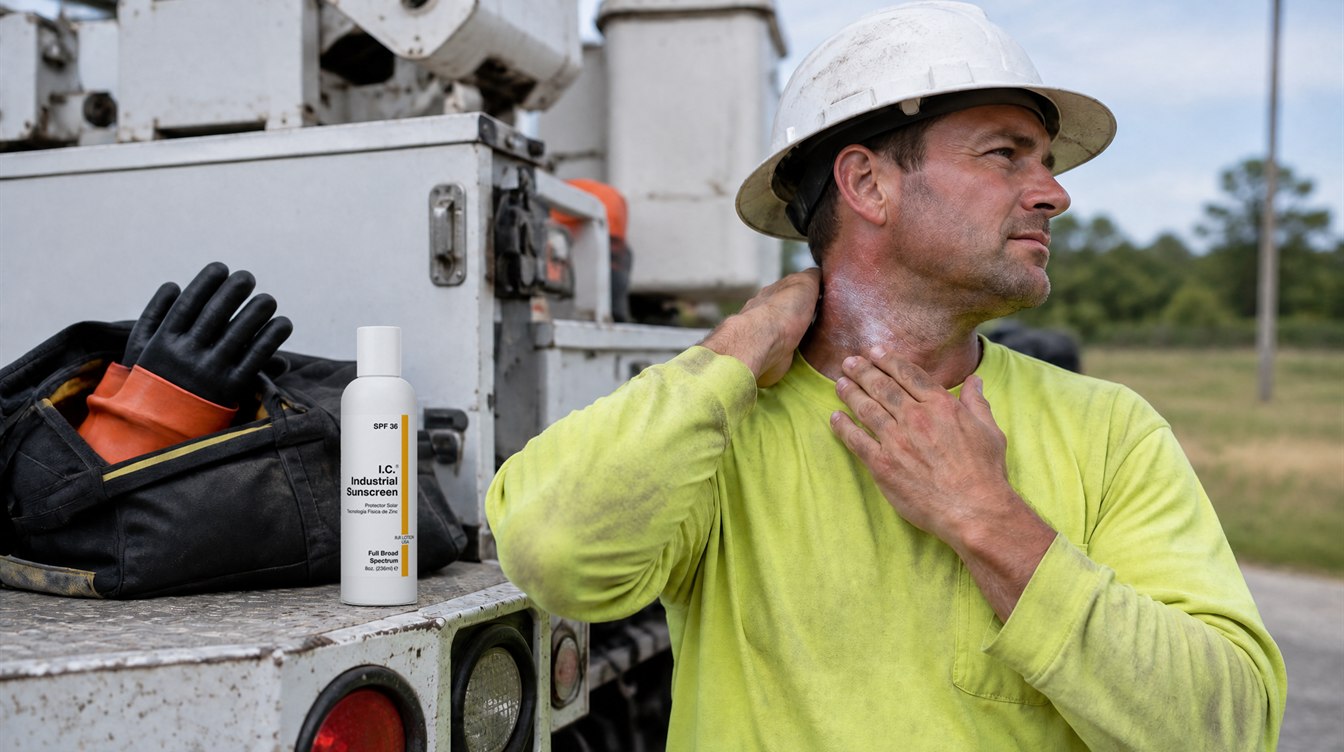
Every lineman has heard it. “Don’t put that stuff on, it’ll eat your gloves.” So a lot of crews skip sunscreen and bug repellent and take the sunburn and the tick bites instead. That is a bad trade, but the worry behind it is fair. Your rubber gloves and your FR clothing are the gear that keeps you alive. Nothing you put on your skin should put them at risk.
That is why you see ASTM numbers on some skin products. This post explains what ASTM D120 and ASTM F2621 actually cover, what a product test can and cannot tell you, and how to use sun and bug protection around your PPE.
Start with the rules you already work under. OSHA’s electrical protective equipment standard, 29 CFR 1910.137, says:
Swelling, softening and stickiness are the signs of rubber that has been attacked by something. Oils and some solvents are well known for it. So the question “will this lotion hurt my gloves” is the right question to ask.
ASTM D120 is the standard specification for rubber insulating gloves. It covers how the gloves are made and tested to protect workers from electric shock. It sorts gloves into Type I (not ozone resistant) and Type II (ozone resistant), and into Classes 00 through 4 by voltage. The tests in the spec include AC and DC proof tests, breakdown tests, a chemical test, tensile strength, tear and puncture resistance.
D120 is a glove standard, not a lotion standard. A sunscreen cannot “be” D120. What a skin-product maker can do is put the product on glove rubber and then run the glove tests from D120 to see whether the rubber still holds up. That is what a “D120 tested” claim on a skin product should mean.
ASTM F2621 is a standard practice for evaluating how safety products respond in an electric arc exposure. The products tested are usually finished, arc-rated items such as garments, gloves, face shields and rainwear. It does not set an arc rating for anything. Arc ratings for fabric come from a different method, ASTM F1959. Flame resistance of fabric is checked with the vertical flame test, ASTM D6413.
For a skin product, the practical question is simple. If it is on your skin and soaks into your FR shirt, does that fabric still behave the way it should in an arc or a flame? Testing answers that by putting the product on FR fabric and then running the arc or flame test on that fabric.
Here is what R&R has on file, in plain terms:
The sunscreen is a hybrid: non-nano zinc oxide plus organic UV filters. It is full broad spectrum SPF 36 and 80-minute sweat and water resistant, and it rubs in clear. Both repellents are EPA-registered and use IR3535. They repel mosquitoes and ticks for up to 8 hours. EPA Reg. No. 70759-2-91651 (lotion) and 70759-3-91651 (spray).
Be clear with your crew about the limits:
For more on sun, ticks and poison ivy on the right-of-way, see our skin care page for linemen and utility crews and Field Notes: Utility & Electrical.
No. D120 is the glove specification. A D120 test on a skin product means glove rubber was exposed to it and then put through D120 glove tests. Your employer’s PPE program and OSHA’s inspection and retest rules still decide what goes in your bucket.
No. ASTM F2621 is a practice for checking how safety products respond to an electric arc. It does not set an arc rating. Fabric arc ratings come from ASTM F1959.
We make our sunscreen as a lotion, not an aerosol. Whatever you use, check whether it has been tested with your gloves and FR clothing, and follow your company’s PPE program.
Keep reading
Stings, ticks, mosquitoes and poison ivy rash are part of tree work. What to keep in the truck kit and how to handle each…
Read article →How to clean an office keyboard, phone and hot desk the right way, how often, and when cleaning isn't enough and you need to…
Read article →Cleaning and disinfecting are two jobs. A between-patient exam table routine for vet clinics, and where a general cleaner does and doesn't fit.
Read article →
Skin care that cares about the worker and about the work
Free samples for crews, safety managers and buyers. Buy direct, through your distributor or on GSA.

Welcome to the crew
Join our email list for your code, plus safety guides, new products and seasonal reminders. A few emails a month.
First order of $40 or more, one per customer. A few small sizes are excluded. Can't be combined with other codes. By signing up you agree to get marketing emails from R&R Lotion. Unsubscribe any time. Privacy Policy
You're on the list
Use it at checkout on your first order of $40 or more. We also sent a confirmation link to your inbox. Click it and we'll email the code so you have it for later.
Start shopping