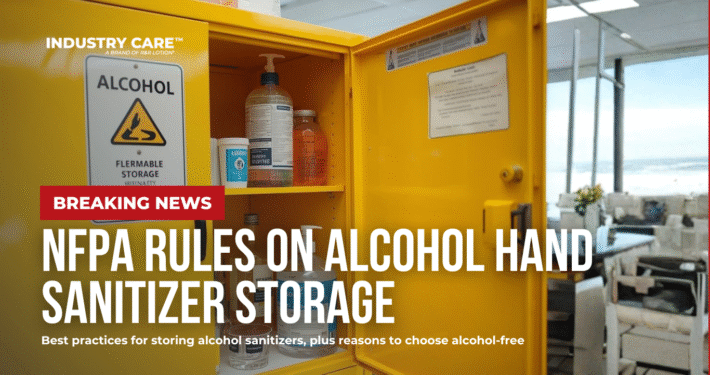
NFPA Rules on Alcohol Hand Sanitizer Storage
Walk any hospital corridor and count the wall dispensers. Each one holds about a liter of alcohol hand rub, and the fire code counts every drop. The NFPA rules on alcohol hand sanitizer storage limit how much alcohol-based hand rub (ABHR) you can mount in one area, where the dispensers can go, and how you store the extra cases. Most of us think of sanitizer as a hygiene product. But to a fire marshal, it is a flammable liquid.
Here is a plain-English guide to the key limits, a checklist you can hand to facilities, and the simpler option many sites are switching to.
What are the NFPA limits, in short?
- In-use volume: commonly 10 gallons per smoke compartment in a building without sprinklers, and 20 gallons in a sprinklered building. That total counts the liquid sitting in dispensers outside of storage cabinets.
- Bulk storage: larger quantities belong in approved flammable-liquid storage cabinets or rooms built to code.
- Dispensers: keep them away from ignition sources, stay within the capacity limit for each unit, and follow the spacing rules.
- The shortcut: alcohol-free products are generally not classed as flammable liquids, so most of these limits stop applying.
Why does hand sanitizer fall under the fire code?
Most alcohol-based hand rubs contain 60 to 95 percent ethanol or isopropanol. Both are flammable liquids. So the codes treat a hallway full of dispensers the same way they treat any other stored fuel. They cap how much can be in use across corridors, rooms and smoke compartments. They also set rules for how bulk supplies are stored, usually in rated cabinets or specially built rooms.
How much alcohol hand rub can you keep in one area?
| Category | Common requirement | What it means for you |
|---|---|---|
| In-use volume (outside cabinets) | Up to 10 gal per smoke compartment without sprinklers; up to 20 gal with sprinklers | Add up the liquid in every dispenser in the area and stay under the limit. |
| Bulk storage | Beyond small amounts, use listed flammable-liquid cabinets or approved storage rooms | Keep cases and jugs inside a listed cabinet or a properly rated room. |
| Dispenser capacity | Each dispenser’s size is limited by location and sprinkler protection | Use the right size unit for corridors, rooms and sprinkler status. |
| Placement | Keep clear of ignition sources; avoid mounting over carpet unless the building is sprinklered | Don’t mount above or beside switches, outlets or open flames. |
| Spacing | Dispenser spacing and exit-path clearances apply | Keep the minimum distance between units and keep exit paths clear. |
One caveat before you build a plan around this table: your local Authority Having Jurisdiction (AHJ) decides which code edition applies and how it is read. So treat these numbers as the common baseline, then confirm them with your fire marshal.
What trips facilities up most often?
Most violations are not about one big drum in a closet. Instead, they come from small things that add up.
- Know your totals. Several wall dispensers in one corridor or suite all count toward the same 10- or 20-gallon limit.
- Space the dispensers. Keep them at least 48 inches (1.22 m) apart horizontally.
- Stay away from ignition sources. That means open flames, outlets and switches.
- Watch the carpet. A dispenser over carpet is only allowed in a sprinklered building.
- Watch the supply closet. More than 5 gallons in one storage spot can trigger NFPA 30 rules for a rated room or cabinet, with fire-resistive construction and automatic sprinklers.
- Check the cabinet itself. A flammable-liquid cabinet can let you store more, but it has to meet code for venting, labeling and clearance.
- Train and label. Make sure staff know the limits, label storage areas, and keep a record of every dispenser and its size for inspections.
Use this checklist before your next inspection
- Inventory every mounted dispenser and total the liquid in each smoke compartment.
- Pick dispenser sizes that fit corridors versus rooms and your sprinkler status.
- Keep units clear of ignition sources, and skip over-carpet installs unless allowed.
- Store cases and refills in approved flammable-liquid cabinets or compliant rooms.
- Document locations, capacities and cabinet specs.
- Review changes with your AHJ, train staff and label storage areas.
Is there a simpler way to stay compliant?
Yes. Take the alcohol out. Alcohol-free sanitizers are generally not classified as flammable liquids, so the volume caps, cabinet rules and spacing limits built around ABHRs mostly fall away. Still, run any change past your AHJ, because local rules vary.
Going alcohol-free also helps in other ways:
- Easier installs. You can put dispensers where people actually need them, not just where the code allows.
- Gentler on hands. Alcohol dries skin, and dry, cracked hands lead to people skipping hand hygiene. Cream and foam formulas moisturize instead.
- More places to use it. Offices, schools, elevators and shared equipment all become easy spots for sanitizer.
- Less risk. No stored fuel means one less fire hazard and one less line item on the inspection report.
Which alcohol-free products do we recommend?
We make two alcohol-free sanitizers with benzalkonium chloride (BZK) as the active ingredient. Both are non-flammable and kill 99.99% of germs.
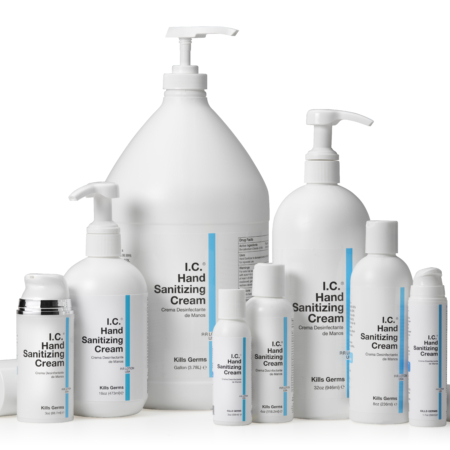
- I.C. Hand Sanitizing Cream: a cream sanitizer for high-touch areas and anywhere an alcohol rub isn’t allowed or practical. It also adds dimethicone as a skin protectant.
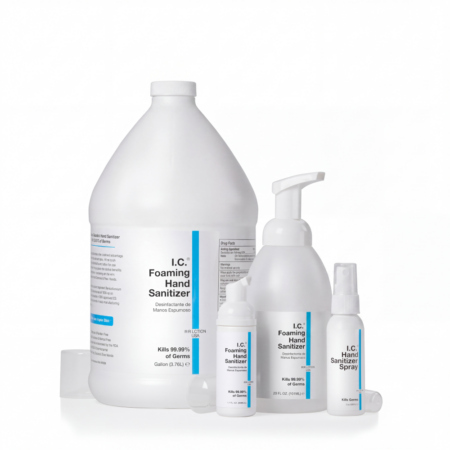
- I.C. Foaming Hand Sanitizer: a quick foam for corridors, waiting rooms and offices. It is NSF E3 registered, so it also works in food-handling areas.
To compare both, see our alcohol-free hand sanitizers. For more on why many facilities make the switch, read about alcohol-free hand sanitizer in prisons and our look at healthcare hand hygiene.
Want help sizing your facility?
Swapping out alcohol rubs is a small change that takes a whole category of fire-code work off your plate. If you want a second set of eyes, contact us or request samples, and we will help you plan the switch.
This article summarizes common NFPA-aligned practices for alcohol-based hand rubs. Always check with your local fire marshal or AHJ for the code edition and requirements that apply to your facility.
Sources
- NFPA 101, Life Safety Code, provisions for alcohol-based hand rub dispensers in health care occupancies.
- NFPA 30, Flammable and Combustible Liquids Code.
- Association for Professionals in Infection Control and Epidemiology (APIC) guidance on ABHR dispenser placement.