








ESD Wash Bottles

(1 customer review)
Price range: $12.60 through $15.99

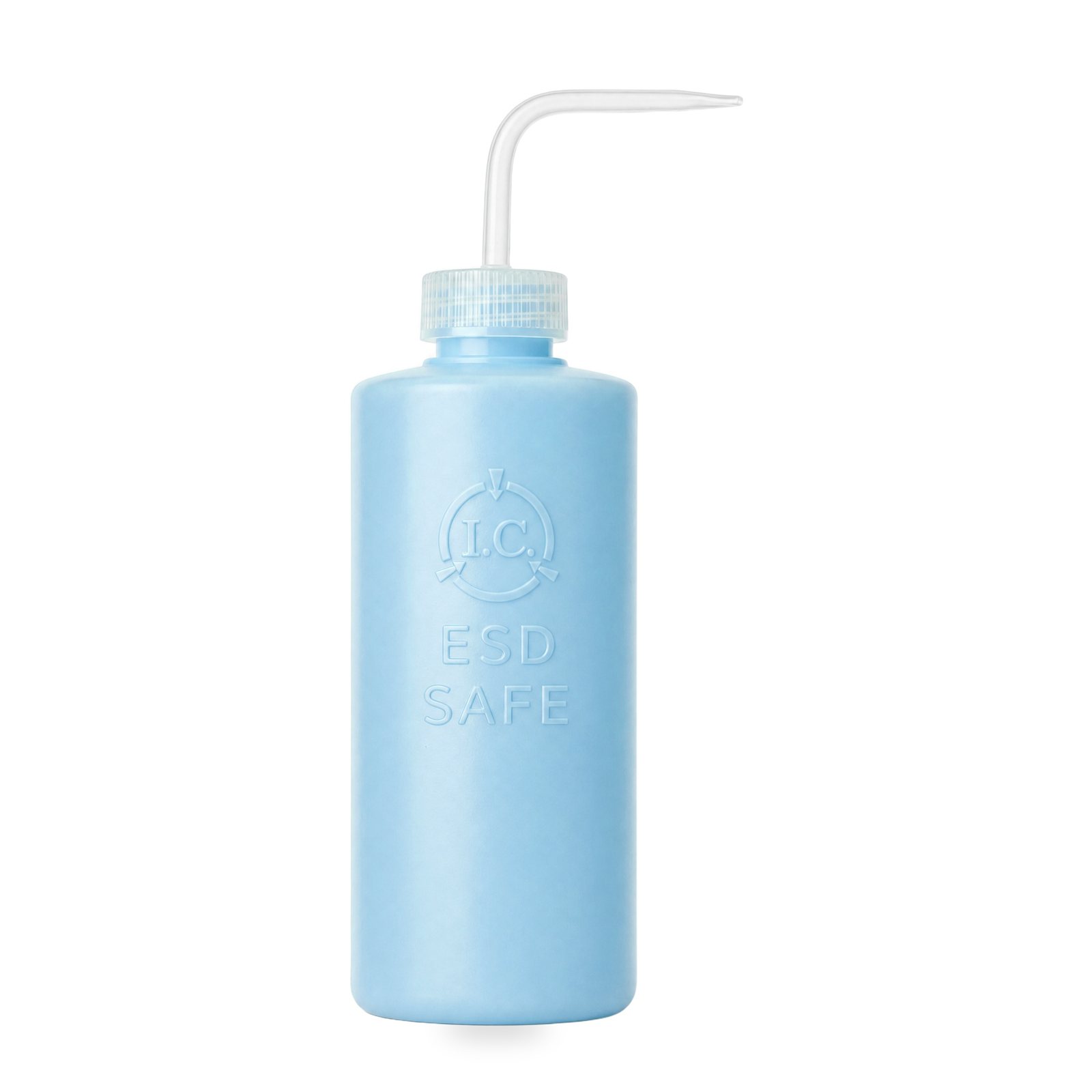
ESD Safe Wash Bottle with 90 degree bent stem  

  • Made in the USAScottsdale, AZ, since 1983
  • FDA registered facilityNo. 3004167955
  • GSA contract holderGSA MAS contract 47QSMS24D0078
SKU: WHB-ESD
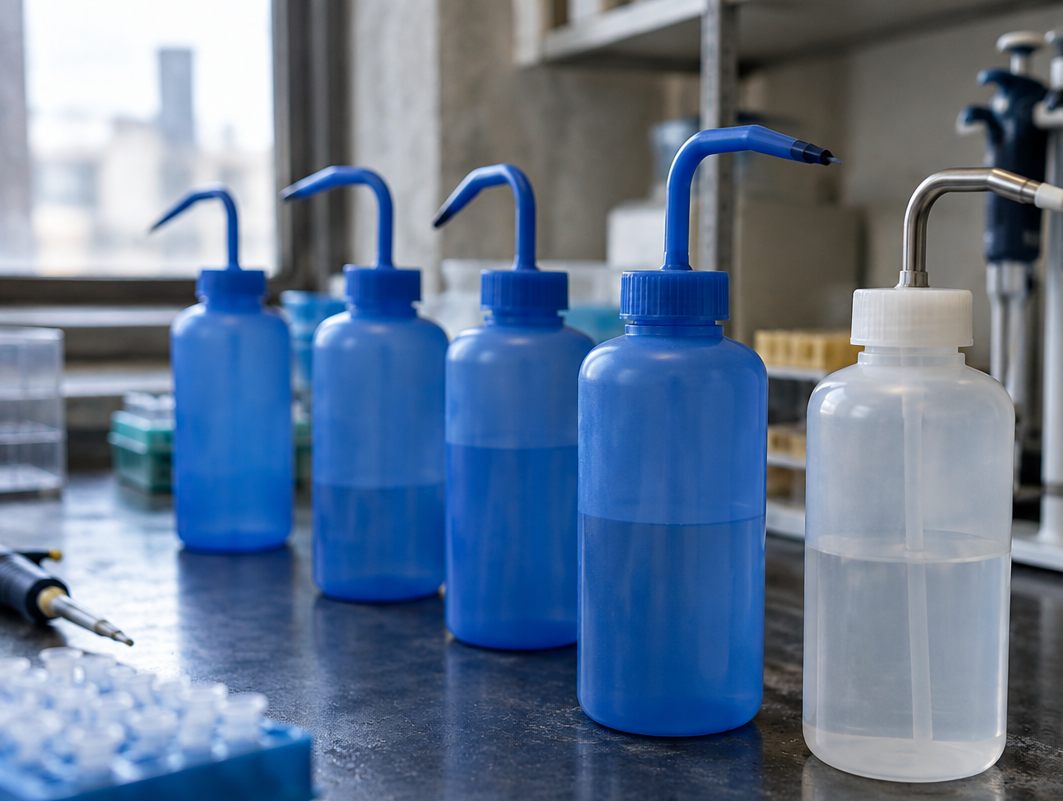
Row of blue wash bottles with bent stems on a lab bench, pipettes behind

Static control at the bench

Built for rinsing at the bench

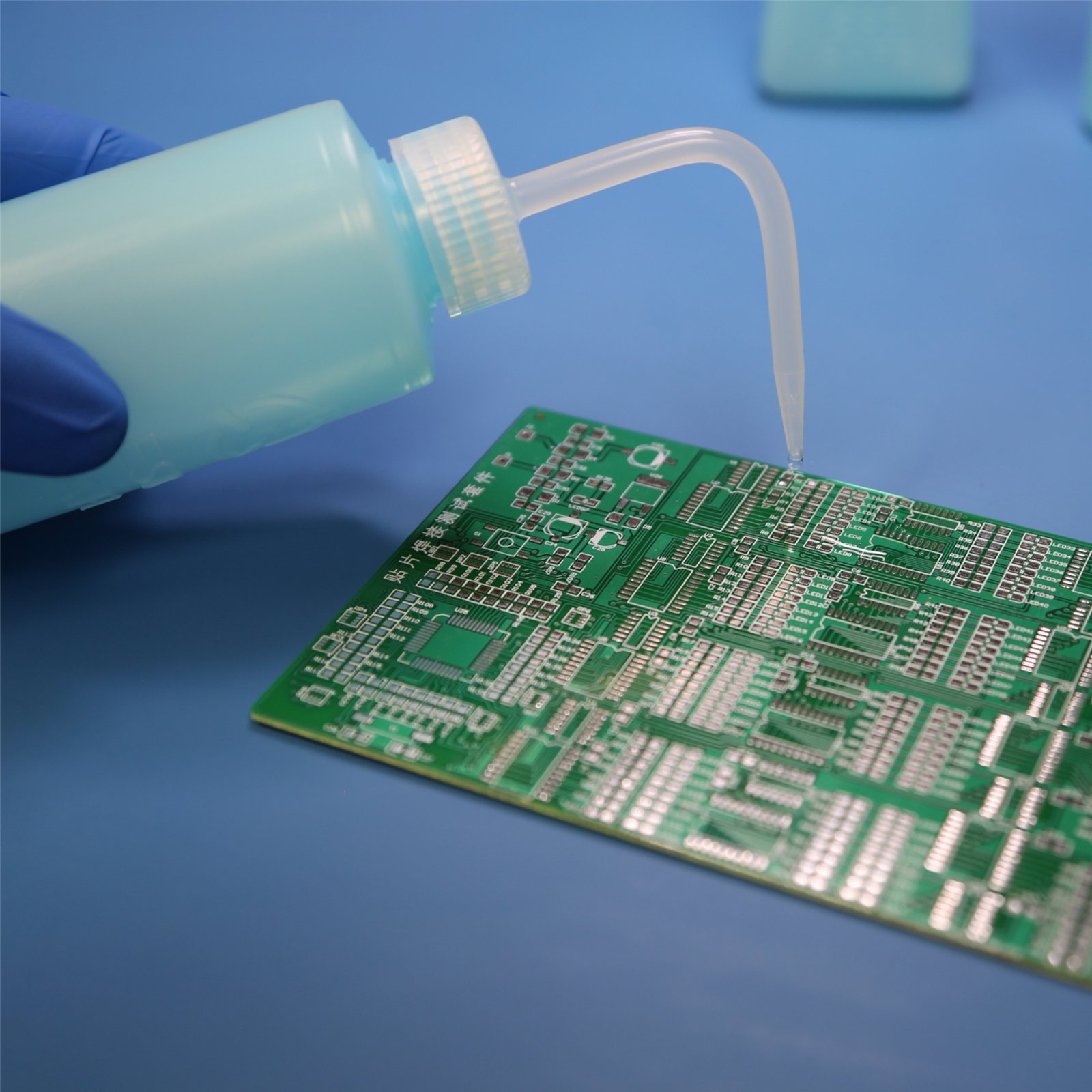
A blue wash bottle with a 90-degree bent stem for rinsing labware and equipment. Cut the spout to set the pressure, and keep it on the ESD bench.

01
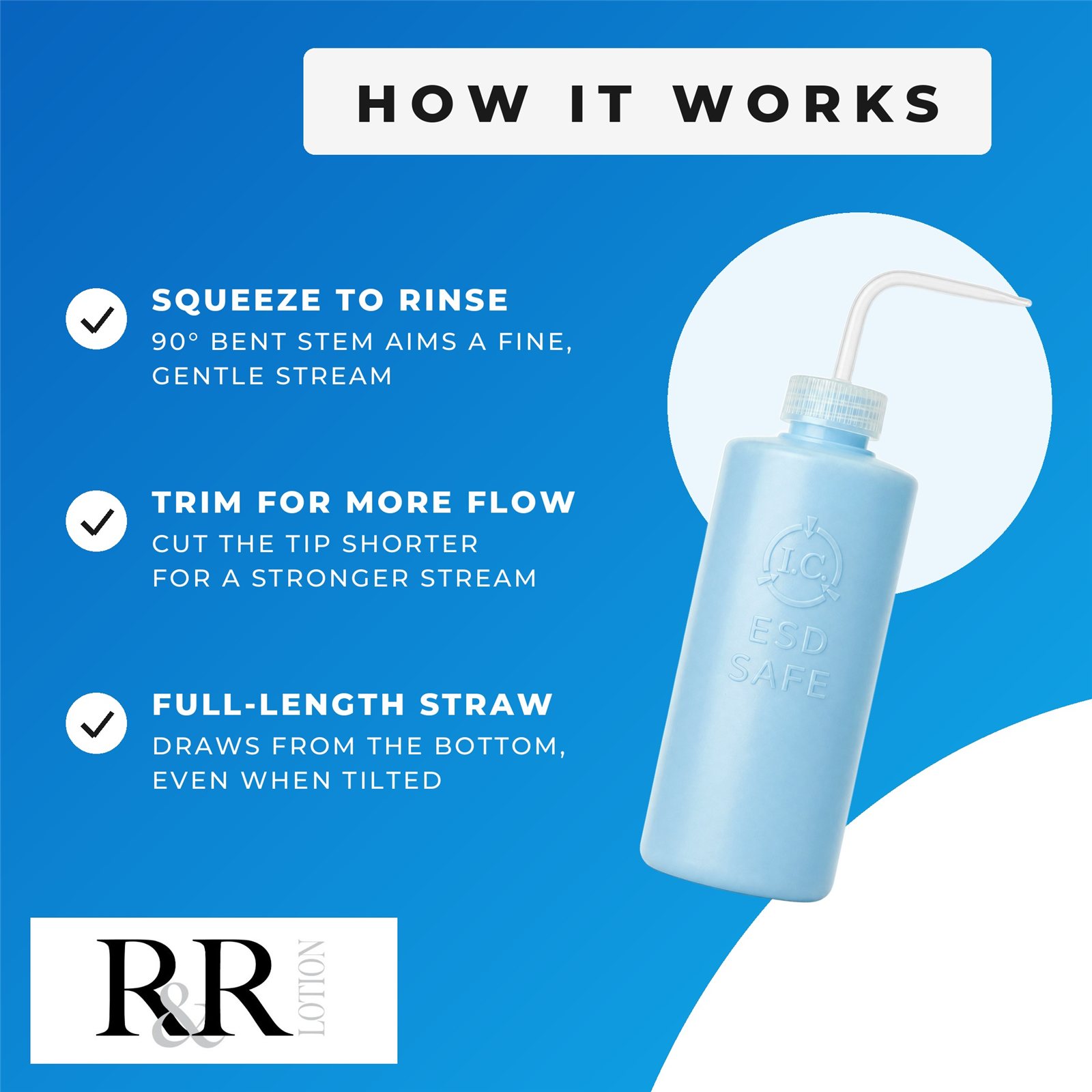
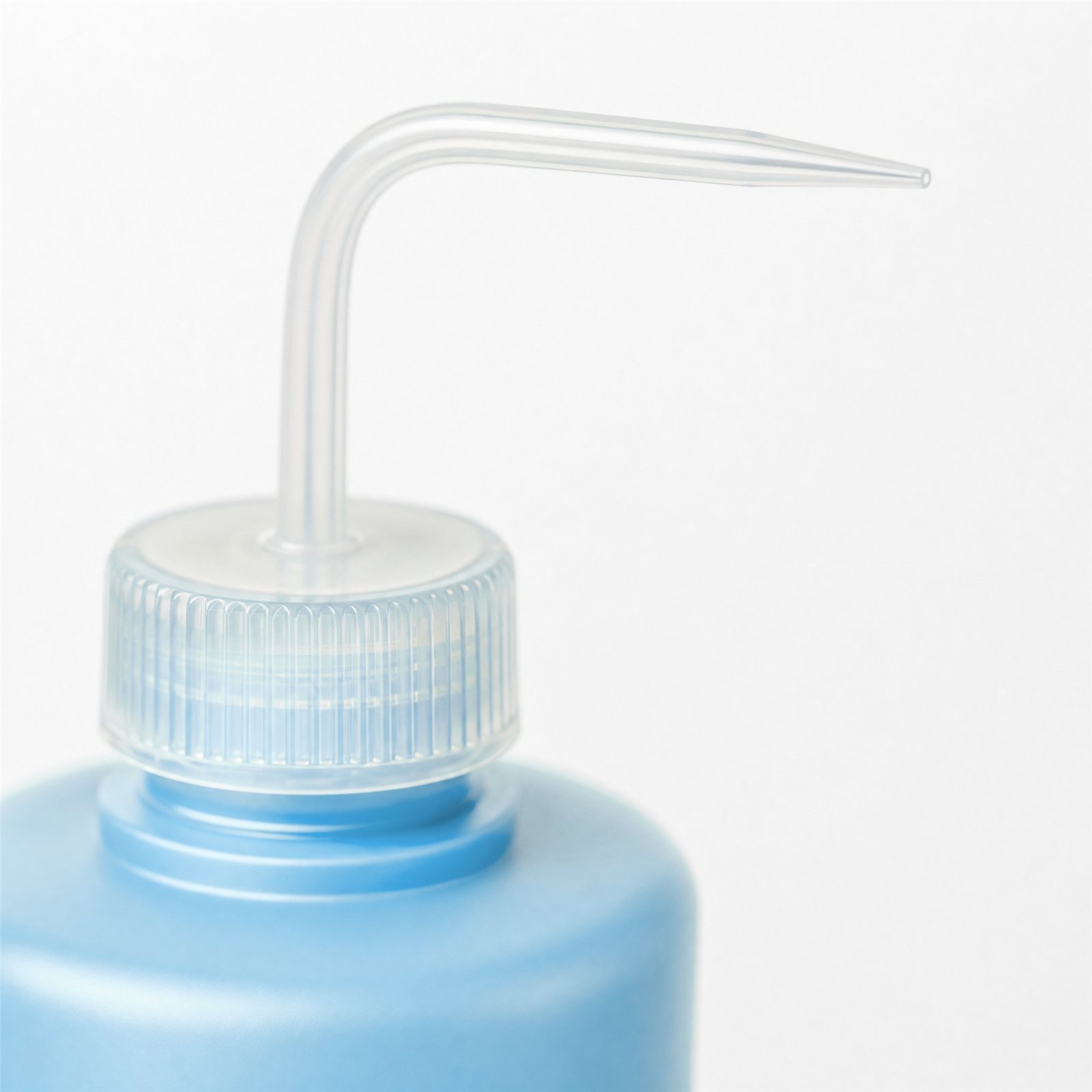
90-degree bent stemAim the rinse exactly where you want it.
02
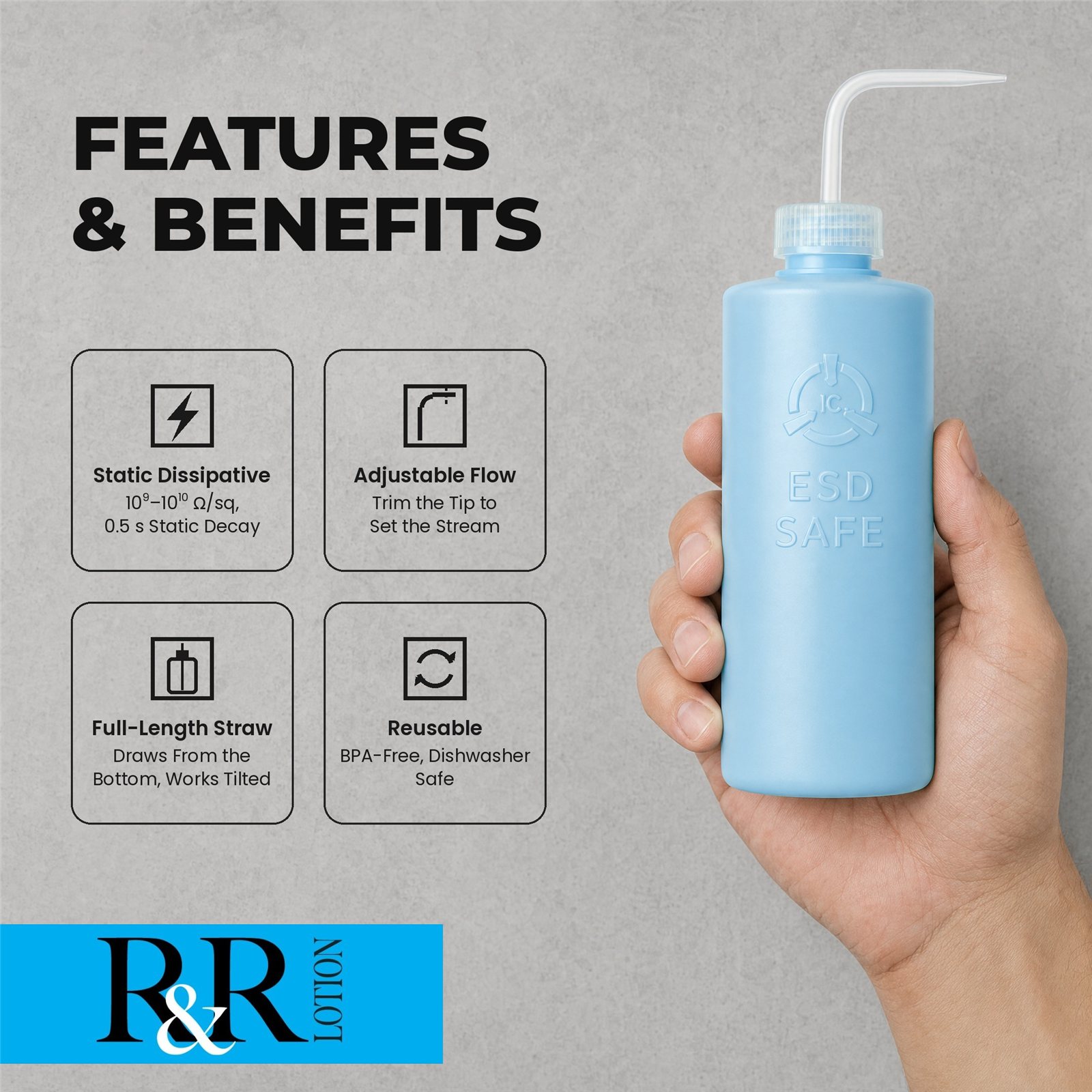
Set your pressureCut the spout to size to customize the stream. A long straw lets you use it at nearly any angle.
03
Static dissipativeAverage surface resistivity of 109 to 1010 ohms/sq, in translucent ESD blue so you can see what is inside.

At a glance

Wash bottle

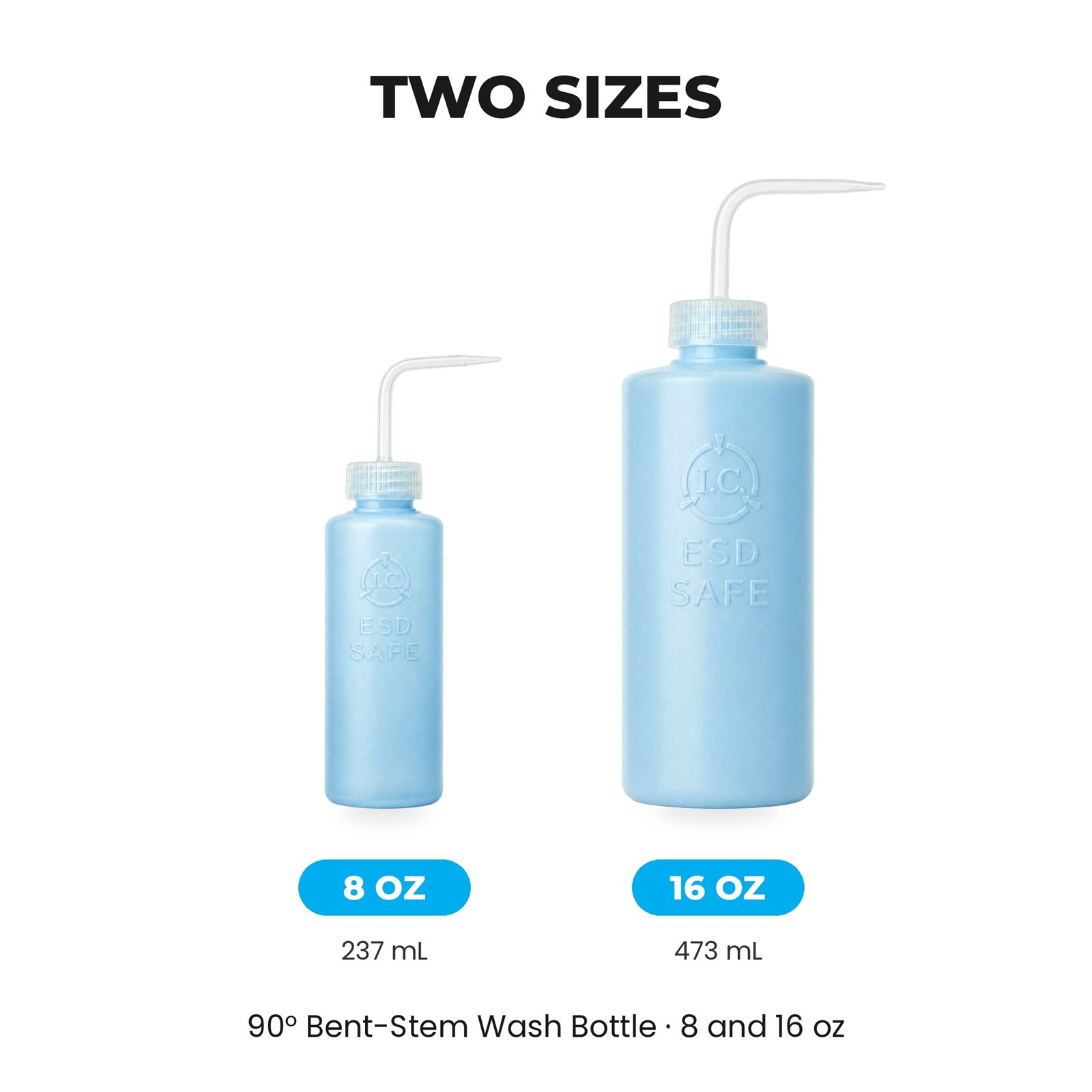
8 · 16 ozWHB-8-ESD and WHB-16-ESD with a 90-degree bent stem tip. Case of 50.
MDPETranslucent ESD blue, molded with an antistatic additive free of amines and amides
109–1010Ω/sq average surface resistivity. Average static decay 0.5 s at 40% RH.
SolventsSeven-day exposure to TCE, MEK and IPA: no color or physical change. See the ESD Bottle Chemical Resistance Chart.

Questions buyers ask

FAQ

What is it for?
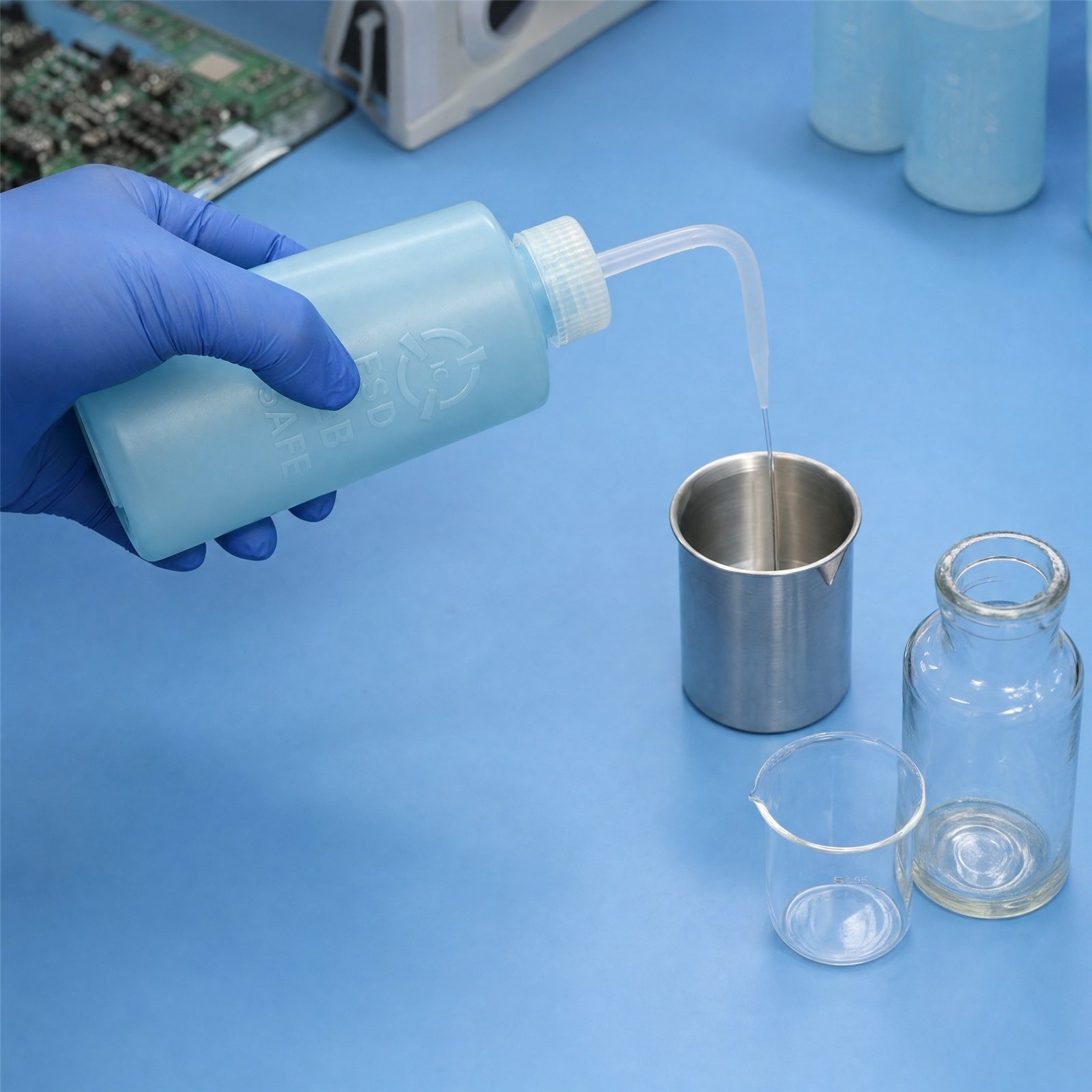
Cleansing or rinsing lab equipment and beakers, and storing cleaning solutions or solvents, in a cleanroom or static-sensitive area.
Wash bottle or water bottle?
The wash bottle has a 90-degree bent stem and a long straw for use at nearly any angle. The water bottle has a Yorker (cone) top for a fine, high-pressure stream.
How do I fill it?
Unfasten the nozzle, fill the bottle, then refasten tightly and press to prime or dispense.
What makes it static dissipative?
It is molded from MDPE with an antistatic additive that contains no amines or amides. Average surface resistivity is 109 to 1010 ohms/sq, with an average static decay of 0.5 seconds at 40% relative humidity. It supports an ANSI/ESD S20.20 program; it does not certify a workstation on its own.
Can I get samples, pricing or buy through GSA?
Yes. Request a sample, ask about distributor and case pricing, or buy WHB-8-ESD and WHB-16-ESD through GSA MAS contract 47QSMS24D0078.

The details

A rinse aimed exactly where you want it

I.C. ESD Wash Bottles are for rinsing labware, beakers and equipment, and for storing washing solutions, in cleanrooms, labs and static-sensitive work areas. The 90-degree bent stem aims the rinse, and a long straw lets you use the bottle at nearly any angle.

Cut the spout to set the water pressure, from a gentle flow to a high-pressure clean. The bottle is static dissipative, with an average surface resistivity of 10⁹ to 10¹⁰ Ω/sq and an average static decay of 0.5 seconds at 40% RH, and its antistatic concentrate contains no ethoxylated tertiary amine.

Choose 8 oz (WHB-8-ESD) or 16 oz (WHB-16-ESD), 50 per case. Both are on GSA MAS contract 47QSMS24D0078. I.C. ESD bottles are molded from MDPE compounded with an ESD additive that gives them their blue tint and static dissipative property, and they are supplied by R&R Lotion of Scottsdale, Arizona, since 1983.

Features & benefits

  • Cut-to-fit spoutCut the spout to set the water pressure.
  • Full-length strawReaches the corner of the bottle, leaving little solution behind.
  • Tilt controlThe bent-stem nozzle and long straw work at most angles.
  • Gentle, direct rinseA gentle yet direct flow for a high-pressure clean.
  • Static dissipativeAverage surface resistivity of 10⁹ to 10¹⁰ Ω/sq, with an average static decay of 0.5 seconds at 40% RH.
  • Supports an S20.20 programSupports an ANSI/ESD S20.20 program. The bottle does not certify a workstation on its own.
  • Amine and amide freeThe antistatic additive contains no amines, amides or ethoxylated tertiary amine, the agent used in many other antistatic bottles.
  • Durable MDPEMedium-density polyethylene is durable and chemical resistant.
  • Grip-right materialFlexible walls give precise, even resistance in the hand.
  • Leak-proof fitEach molding is fitted to its matching top and seals when closed.
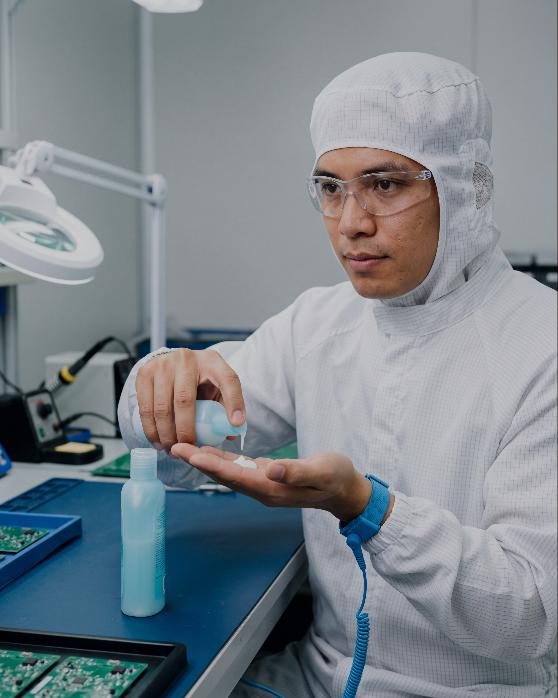
  • Into the ESD areaBring liquids and supplies into static-sensitive areas in a static dissipative container, and keep them within reach at the workstation.
  • ESD blue, translucentThe ESD blue tint is easy to spot, and the translucent wall shows contents and fill level.
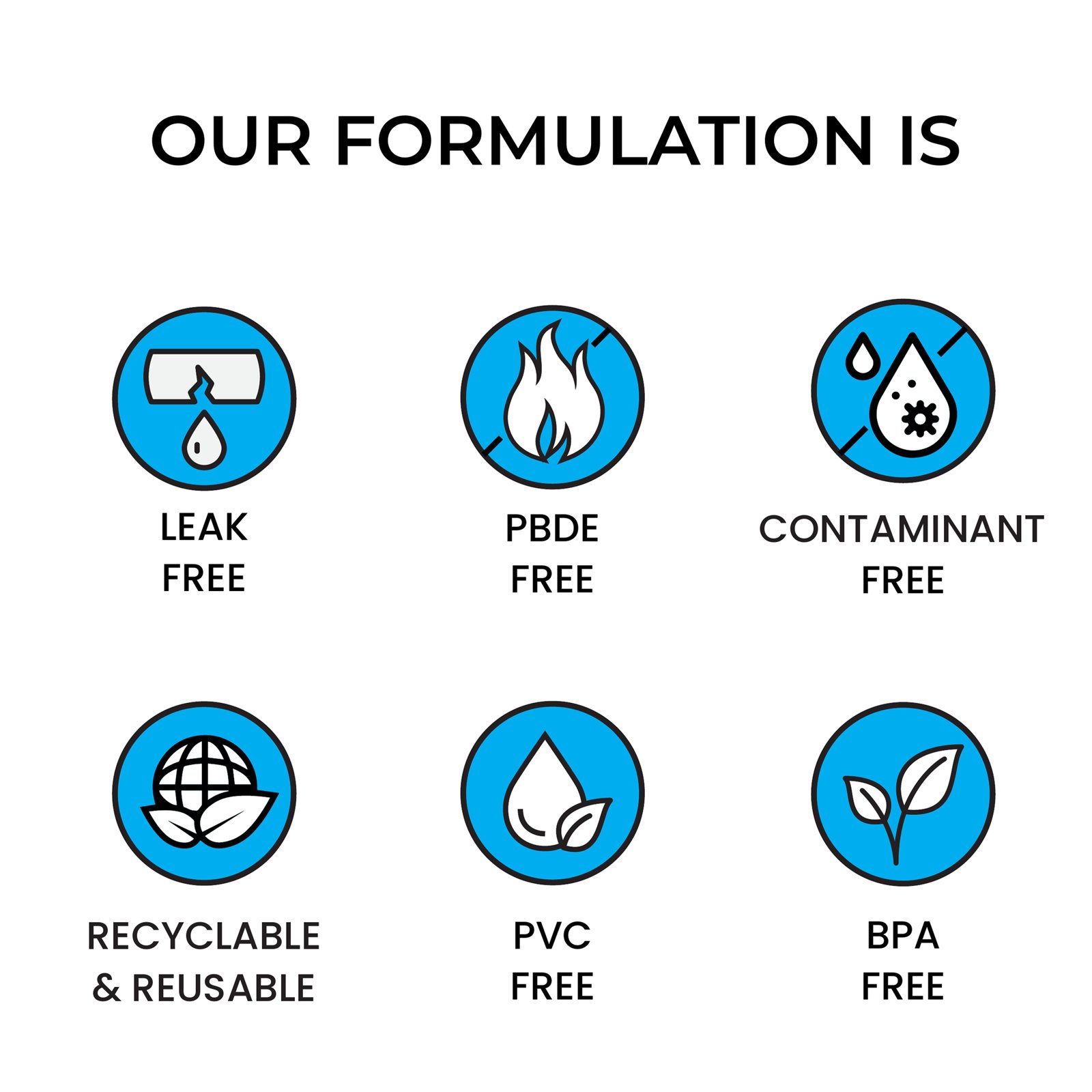
  • Clean plasticMade with no BPA, PBDE, phthalates or heavy metals.
  • Non-stick surfaceContents release cleanly from the plastic surface.
  • Odor resistantDoes not hold trace odors or fragrances left by solvents and other chemicals.
  • Top-rack washableWash on the top rack of a dishwasher and reuse.
  • RecyclableThe material is formulated to be recyclable and reusable.

Uses (from the label)

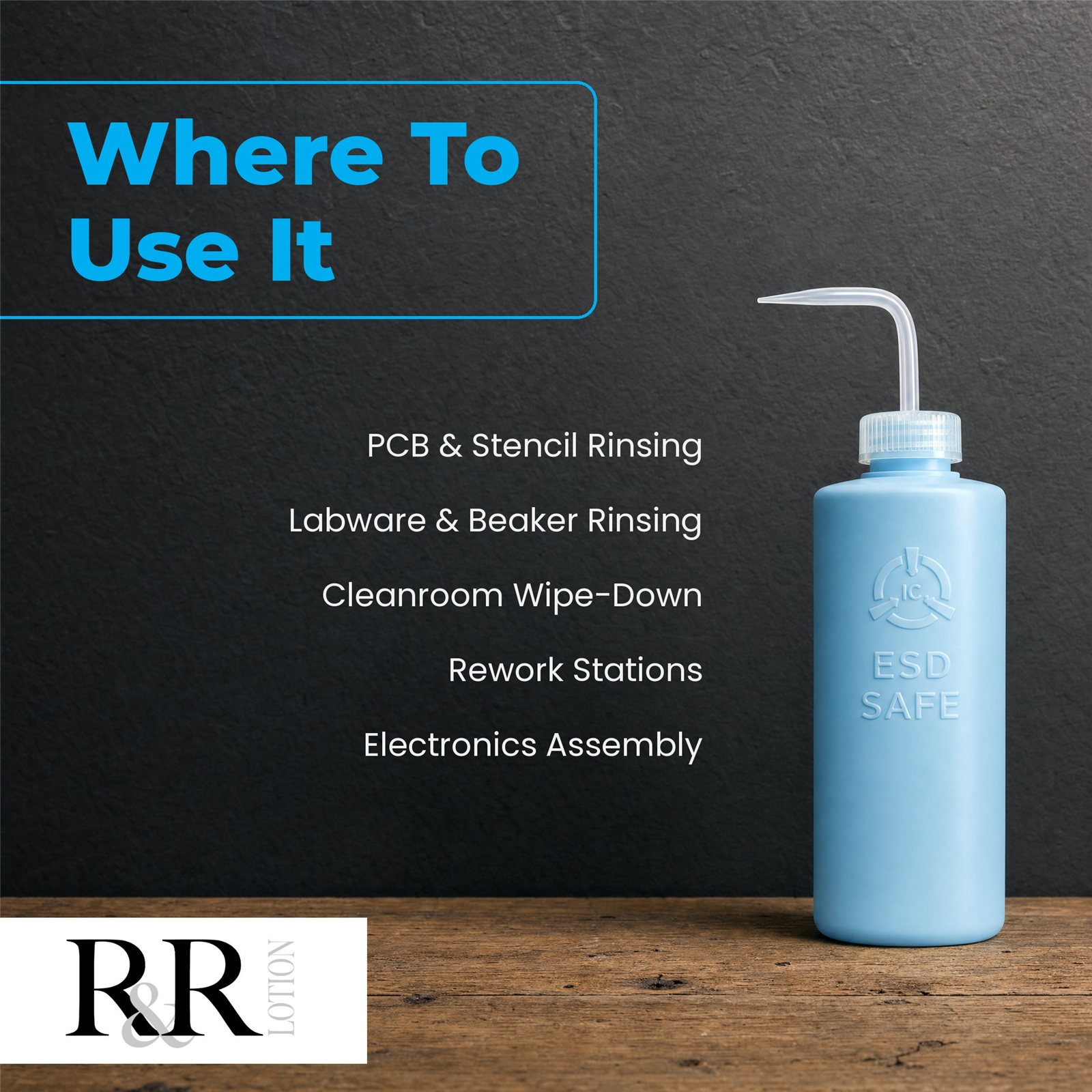
  • Cleanrooms and sterile environments
  • Cleansing or rinsing lab equipment and beakers
  • Storing cleaning solutions or solvents

Free ofBPAPhthalatesPVCPBDEHeavy metalsAmines and amides

Sizes & case packs

SizePart no.Per case
8 oz wash bottle, 90° bent stemWHB-8-ESD50
16 oz wash bottle, 90° bent stemWHB-16-ESD50

Directions for use

  1. Unfasten the nozzle from the bottle to fill the ESD bottle with solution.
  2. Tightly refasten the nozzle and press to prime or dispense solution.

Applications

Electronics manufacturingCleanroomsStatic-sensitive environmentsSemiconductor and quality labsBio-science labsAerospace and defense

Testing on file

  • Static decay, 5 kV at 40% RHAverage 0.05 s to the 1% cutoff (min 0.04 s, max 0.07 s); 0.03 s average to 10%.
  • Surface resistivity, ASTM D2571.97 × 10¹⁰ Ω/sq average at 100 V and 40% RH.
  • Surface resistance, 100 V at 40% RH5.51 × 10⁸ Ω average (1% cutoff).
  • Static decay, packaging material5 kV at 15% RH: PVC sleeve 0.35 s, PE foam 0.17 s, PS foam 0.17 s.
  • Solvent residue, seven-day exposureTCE, MEK and IPA: no color or physical change; water pH unchanged (about 5.9).
  • Electro-Tech Systems, 2015Surface resistivity at 40% RH (ASTM D257 / ESD S11.11) in the static dissipative range; static decay at 12% RH (Mil-Std-3010C Method 4046) to the 1% cutoff in about 0.01 s.

Product specs

Product type
Static dissipative bottle (hardware)
Material
MDPE with an antistatic additive (amine and amide free)
Color
ESD blue, translucent
Surface resistivity
10⁹ to 10¹⁰ Ω/sq (average)
Static decay
0.5 s average at 40% RH
ESD program
Supports an ANSI/ESD S20.20 program; does not certify a workstation on its own
Standards (per TDS)
Exceeds MIL-B-81705 and NFPA-56A (FTMS 101, Method 4046); tested to ESD ADV 11.21; meets EIA 625; helps meet ANSI/ESD S4.1; DOD-HDBK-263
Food-contact material
MDPE and additive comply with 21 CFR 177.1520, 178.2010, 178.3297 and 178.3120
Chemical compatibility
See the ESD Bottle Chemical Resistance Chart, rrlotion.com/esd-bottle-chemical-resistance-chart/
Flammable liquids
Not ATEX rated
Regulatory lists
Prop 65, TSCA, SARA, REACH, RoHS: no known substances
Shelf life
At least 24 months from manufacture. Some ESD bottles degrade over time depending on the solvent and frequency of use.
Cleaning
Top rack of a dishwasher
SDS
ESD Bottles SDS, rrlotion.com/msds/
Supplied by
R&R Lotion, Scottsdale, AZ, since 1983 · FDA registered facility No. 3004167955
GSA
MAS contract 47QSMS24D0078: WHB-8-ESD, WHB-16-ESD

1 review for ESD Wash Bottles

  1. motocoder –

    I use this to hold distilled water that I use to rehydrate the tip cleaning sponge on my soldering station It works great and doesn’t spill water. Very convenient.

Add a review

Your email address will not be published. Required fields are marked *

For safety managers & buyers

Spec sheets, SDS & test reports

Everything your safety team or purchasing department needs, ready to download.